

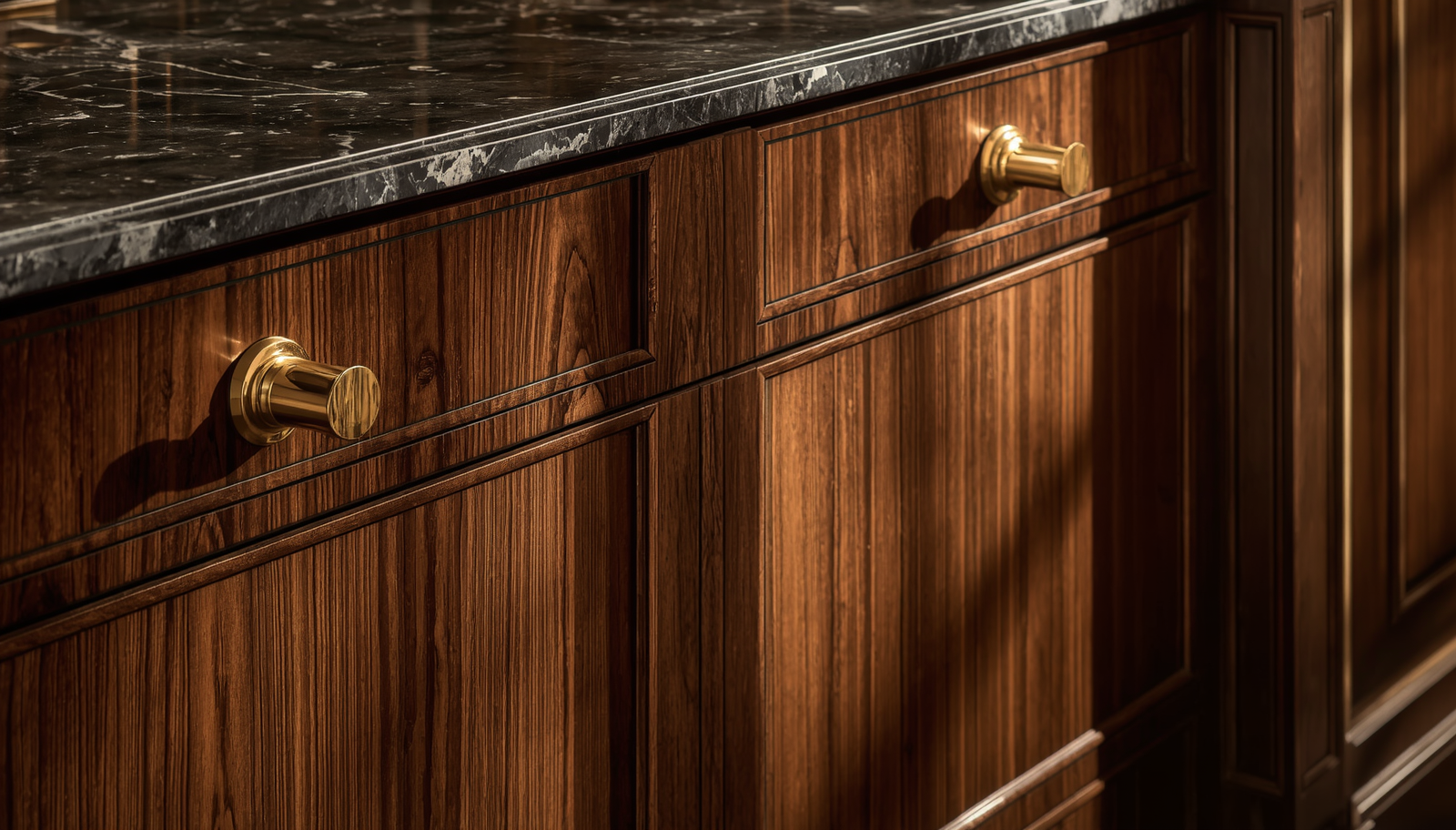
Inside Cabinetry
In high end kitchen design, cabinetry is not just a visual choice it’s a structural decision that affects performance, storage efficiency, and long-term durability. At Blue Ribbon Millwork, we approach cabinetry as architectural engineering, not off-the-shelf furniture. Two dominant construction systems define today’s luxury kitchens: framed and frameless cabinetry. While they may appear similar at first glance, their internal engineering tells a very different story.
Framed cabinetry is based on a reinforced front structure that supports the entire cabinet box. This frame acts as a stabilizing perimeter, improving rigidity and helping maintain alignment over time.
It is a system rooted in craftsmanship tradition, commonly used where structural forgiveness and adaptability are required during installation.
High structural reinforcement through front framing
Better resistance to structural shifting over time
Easier on site adjustment during installation
Strong compatibility with custom and irregular layouts
Reduced internal usable space due to frame depth
Additional finishing work required on exposed sides
More visually traditional in appearance
This system is often selected for projects that prioritize durability and flexibility over minimalism.
Frameless Engineering: Precision Driven European Design
Frameless cabinetry removes the front frame entirely, allowing doors and drawers to attach directly to the cabinet carcass. This creates a cleaner interior structure and significantly improves usable storage capacity. This is a precision based system that depends heavily on manufacturing accuracy and installation discipline.
Maximum interior storage efficiency
Wider drawer openings and improved accessibility
Seamless, uninterrupted exterior surfaces
Factory finished edges for a refined architectural appearance
Requires extremely precise fabrication tolerances
Less forgiving during installation adjustments
Alignment depends entirely on panel accuracy
Frameless systems are typically chosen for contemporary luxury kitchens where minimalism and efficiency define the design intent.
Engineering Perspective: How Structure Changes Everything
The key distinction between both systems lies in load distribution and structural reinforcement.
Framed cabinets rely on a perimeter structure that helps stabilize the box and reduce deformation under stress. This improves long term dimensional integrity.
Frameless systems shift all structural responsibility to the cabinet panels themselves, which demands higher manufacturing precision but results in a more efficient internal layout.
Installation Reality: Two Completely Different Workflows
Installation methods are not interchangeable each system requires a distinct approach.
Fastening occurs through the front frame
Allows deeper anchoring points
More forgiving alignment tolerances
Suitable for field adjustments
Fastening is done through side panels
Requires multiple precise anchor points
Demands perfect leveling from the start
Minimal tolerance for correction after installation
Design Expression Through Overlay Systems
Overlay defines how cabinetry interacts visually with its frame or structure:
Inset: Doors sit inside the structure for a furniture-grade finish
Partial Overlay: Balanced exposure of cabinet frame
Full Overlay: Near complete coverage for a clean architectural surface
Frameless cabinetry naturally aligns with full overlay design, reinforcing its seamless visual identity.
2026 -2027 Direction: What Luxury Kitchens Are Moving Toward
Luxury kitchen design is evolving toward engineered simplicity where performance is just as important as appearance.
Key industry shifts include:
Sustainable, traceable material sourcing
Integrated soft close and silent hardware systems
Hidden storage engineering and spatial optimization
Matte, tactile, and non reflective surface finishes
Architectural integration of cabinetry into the home structure
The focus is no longer decoration it is precision, longevity, and spatial intelligence.
Final Insight
Choosing between framed and frameless cabinetry is not a style preference it is a structural design decision that defines how a kitchen performs over time. At Blue Ribbon Millwork, both systems are engineered with precision, allowing designers, builders, and homeowners to align function with architectural intent at a luxury level.
It's the next best thing to signing up yesterday.
