

Inside Cabinetry
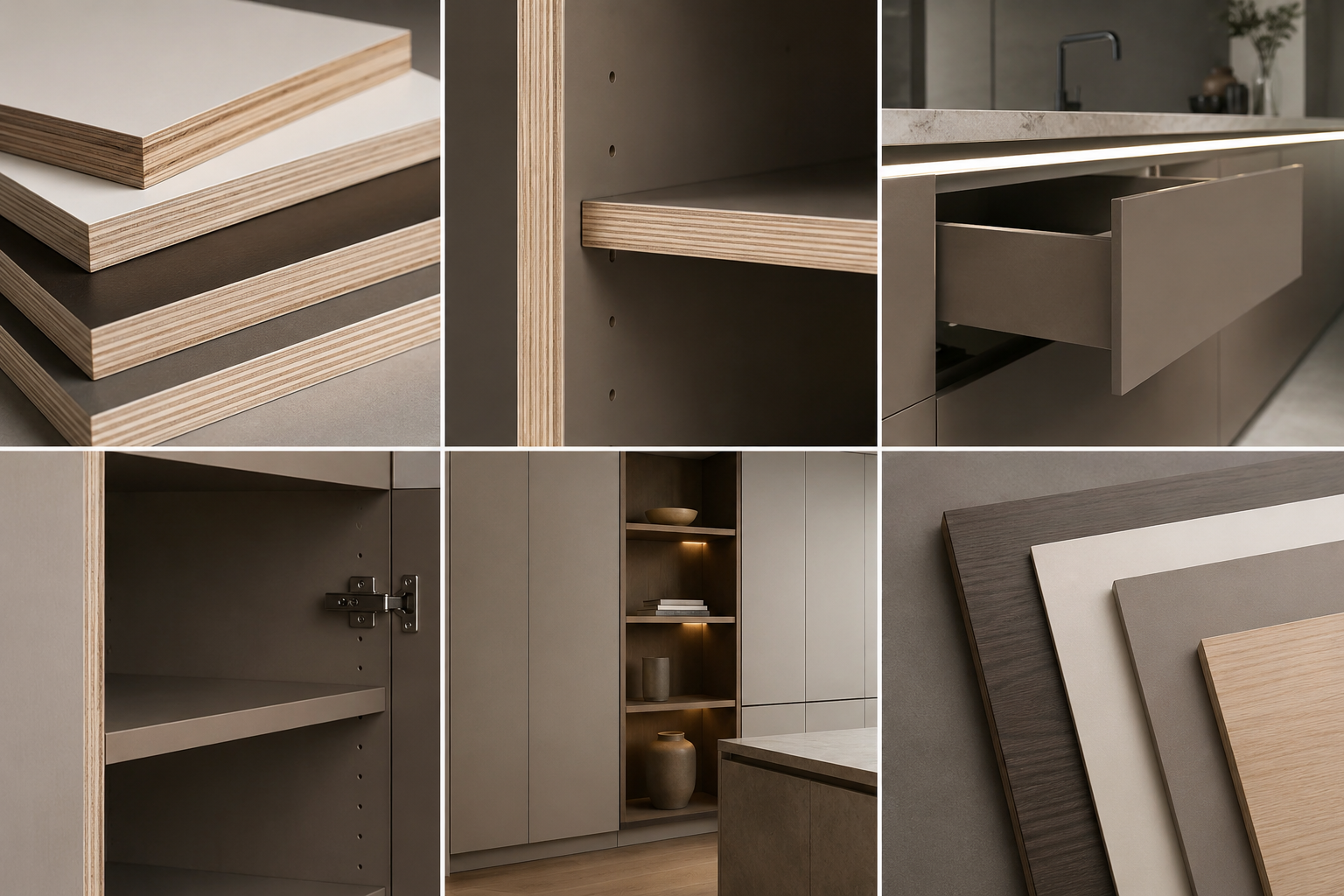
In high end interiors, cabinetry is never just storage. It is architecture at a smaller scale built, refined, and engineered to define how a space feels long before it is ever noticed. Behind every seamless kitchen or integrated millwork wall, there is a deliberate material language. Two of the most essential components in modern custom cabinetry are plywood and melamine. Not as competing choices, but as coordinated elements within a single design system.
The Material Logic Behind High End Custom Cabinetry
In luxury millwork, materials are not chosen for appearance alone. They are selected for performance, stability, and how they behave once they become part of a built environment.
Behind every refined kitchen, every seamless wardrobe system, and every integrated architectural wall, there is a structural decision that determines the lifespan and integrity of the entire project.
Two of the most essential materials in modern custom cabinetry are plywood and melamine. They are not interchangeable, nor are they competitors. They serve different roles within a single engineered system.
Plywood: The Structural Core of Custom Millwork
Plywood is one of the most trusted structural materials in custom cabinetry because of its engineered composition.
It is made from multiple layers of real wood veneer, pressed together with alternating grain directions. This cross laminated construction is what gives plywood its strength and dimensional stability.
In practical application, plywood is used as the structural framework of cabinetry:
Cabinet boxes (carcasses)
Load bearing components
Areas requiring screw holding strength
Long term structural stability in kitchens and built-ins
Unlike lower grade panel materials, plywood resists warping and maintains its shape over time, especially in environments exposed to humidity and temperature changes such as kitchens and bathrooms.
In high end millwork, plywood is not chosen for visibility. It is chosen for permanence.
It is the material that ensures everything stays aligned long after installation.
Melamine: Controlled Finish and Interior Precision
Melamine is an engineered panel material composed of a particleboard or MDF core finished with a heat-fused resin surface layer.
Its value is not structural strength, but surface control and consistency.
In custom cabinetry, melamine is commonly used for:
Interior cabinet surfaces
Closets and storage systems
Shelving and compartmentalized interiors
Non load bearing panels
What makes melamine important in modern millwork is its precision in finish. It provides:
Consistent color and texture across large projects
High resistance to wear in interior use
Easy maintenance and cleaning
A clean, controlled visual language
In luxury cabinetry systems, melamine allows designers to maintain visual order inside cabinetry, where functionality is prioritized over material expression.
It is about efficiency, clarity, and consistency.
How Plywood and Melamine Work Together
In high end custom cabinetry, plywood and melamine are not competing materials they are complementary layers of a single system.
Each has a defined role:
Plywood provides structure
Melamine provides interior finish consistency
This separation of function allows millwork to achieve both durability and visual control without unnecessary cost or material redundancy.
A well designed cabinet system uses plywood where strength is required and melamine where precision finishing is needed.
This is not simplification it is engineering efficiency.
Why Material Choice Matters in Luxury Millwork
In custom cabinetry, material selection is not a cost decision. It is a performance decision.
The difference between standard cabinetry and high end millwork is often invisible to the eye but fundamental in execution:
Structural stability over years of use
Resistance to movement and warping
Clean integration with hardware systems
Precision alignment across large installations
Luxury interiors are defined by how long they maintain their original condition. Materials like plywood and melamine are selected not because they are the most expensive, but because they are predictable, stable, and engineered for consistency.
Final Perspective
In modern millwork, luxury is not defined by surface complexity.
It is defined by control.
Control over structure.
Control over finish.
Control over how materials behave over time.
Plywood and melamine are two of the most important tools in achieving that control.
One builds the structure you never see.
The other defines the surfaces you interact with every day.
Together, they form the foundation of modern custom cabinetry.
It's the next best thing to signing up yesterday.
