


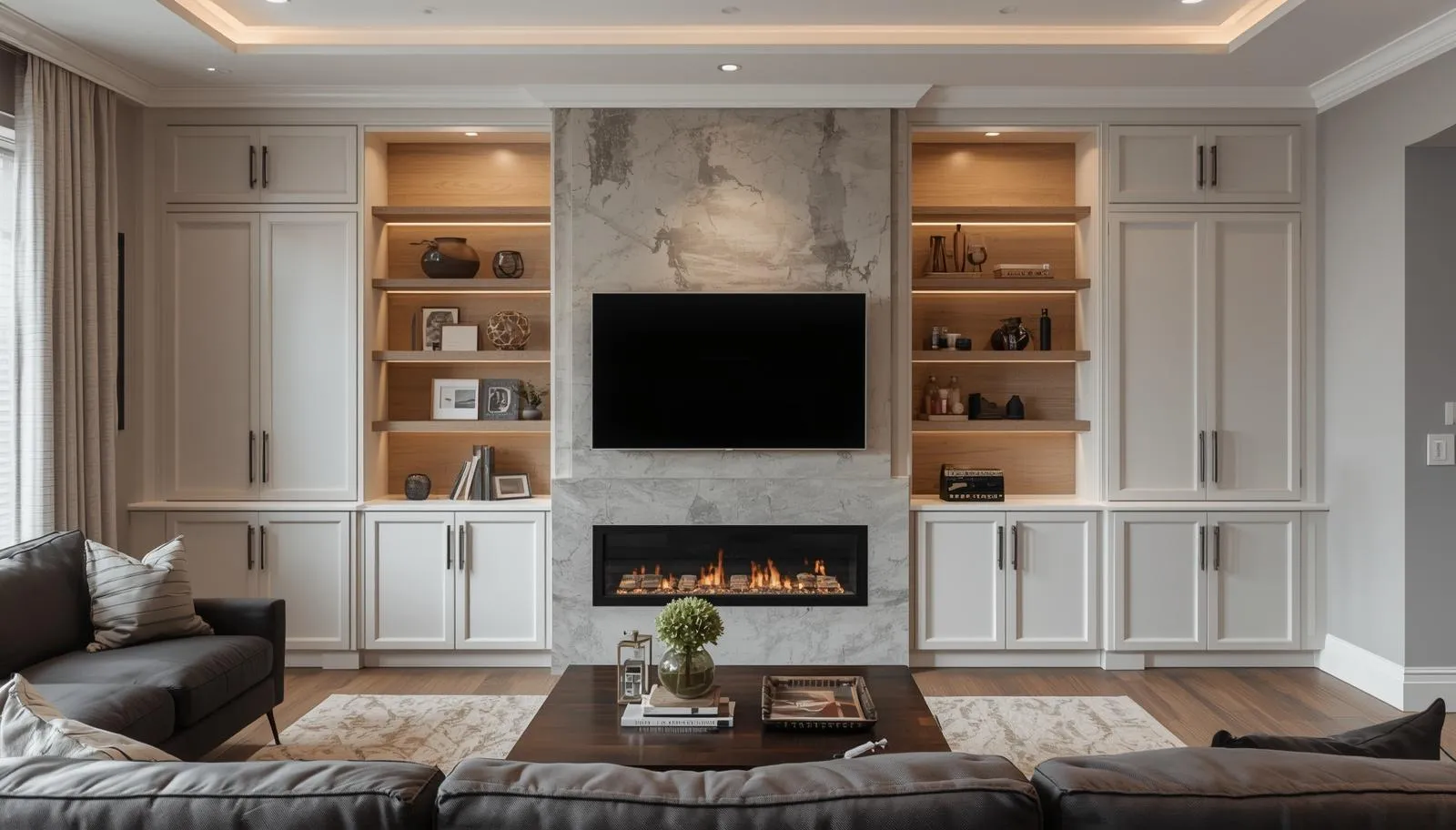
The Fireplace Wall Is Not a Feature It’s a System
In many homes, the fireplace wall is treated as decoration. Cabinets are added around it as support pieces.
In well designed spaces, the entire wall is considered as one composition.
That means the fireplace, media integration, cabinetry, ceiling height, and wall proportions are all resolved together from the beginning. When this happens, the result feels intentional and permanent. When it doesn’t, it always feels like something was added after the fact.
Design the Entire Wall Before You Design the Units
Strong built in design starts by stepping back from individual elements.
The wall should be evaluated as a full architectural surface:
its width, vertical scale, ceiling alignment, and relationship to adjacent spaces all influence how the built ins should behave. The fireplace is not the center of the design it is one component inside a larger structure. When the wall is designed holistically, cabinetry stops feeling modular and starts feeling architectural.
Balance Is Not Symmetry
One of the most common misconceptions in built-in design is that both sides need to match. Symmetry can work in formal spaces, but it is not a requirement for good design. Depending on the room, balance can be achieved through:
weighted storage on one side, asymmetrical shelving compositions, or visual counterbalance between closed and open volumes. What matters is not duplication it’s equilibrium within the space.
Integrating Media Without Letting It Dominate the Room
Television placement often dictates the entire wall if it is not handled carefully.
Custom millwork allows the media element to be integrated rather than exposed as a standalone object.
This can be achieved through recessed framing, panel integration, or aligning the screen with surrounding cabinetry proportions so it becomes part of the composition instead of the focal interruption.
The goal is simple: the media should be present, but not visually dominant.
Controlled Contrast Between Open and Closed Storage
Built-in walls lose clarity when everything is treated the same way.
A strong composition balances:
open shelving for curated objects, closed cabinetry for functional storage, and transitional zones that connect both visually.
This layering prevents visual overload while still allowing the space to feel lived-in and personal.
Without this balance, built-ins either feel empty or overwhelming.
Materials Set the Entire Tone of the Space
Material selection determines whether the wall feels architectural or purely decorative.
Painted millwork creates a clean, continuous surface that blends into the architecture. Wood introduces warmth and depth, grounding the space visually. Panelized systems create a seamless effect where storage disappears into the wall itself.
Consistency across the entire installation is what creates a true built in expression not just cabinetry placed beside a fireplace.
Proportion Is Where Most Built Ins Fail
Even well conceived designs break down when proportions are ignored.
Shelf thickness, cabinet depth, vertical alignment, and spacing all need to respond to the scale of the room and the fireplace.
If one element is off, the entire composition feels unresolved.
This is where custom millwork becomes essential everything is built to the architecture instead of being forced into it.
From Furniture to Architecture
When done correctly, a fireplace wall stops reading as furniture.
It becomes part of the structure of the home visually anchored, proportionally integrated, and permanently connected to the space.
That shift is what separates standard built-ins from architectural millwork.
It is no longer about filling a wall. It is about defining it.