


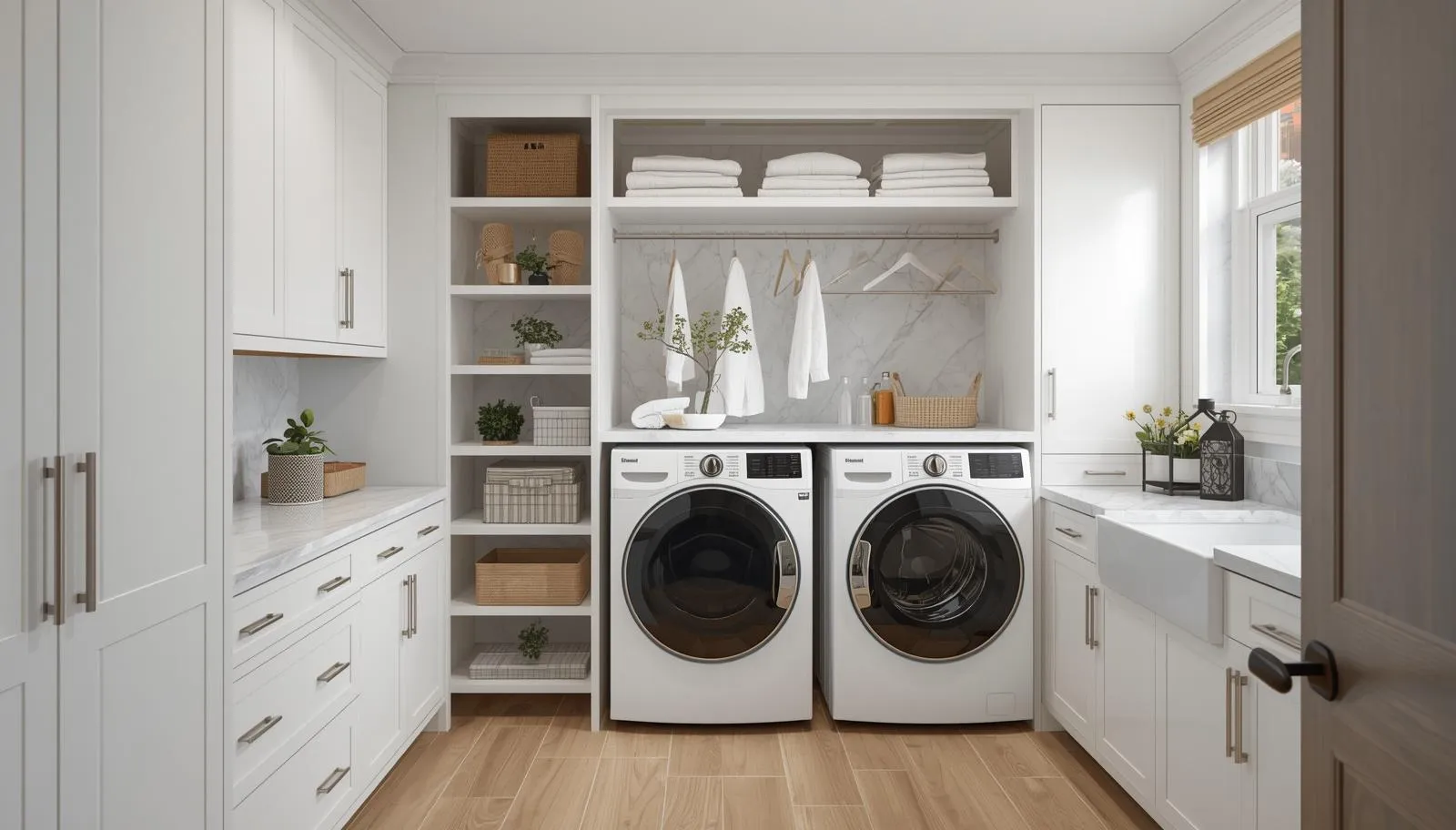
Laundry Should Follow a Sequence, Not a Surface
Most laundry rooms fail because they are designed as storage rooms instead of workflow spaces.
When the process is unclear, tasks break down into clutter: clothes pile on machines, detergents spread across counters, and finished laundry stays in baskets longer than necessary.
A well-designed laundry room removes that friction by structuring the space around movement not objects.
A Folding Zone That Actually Prevents Bottlenecks
One of the most overlooked elements in laundry design is a dedicated folding surface.
Without it, the top of machines becomes the default workspace, which quickly turns into visual and physical chaos.
A proper folding counter creates separation between “in progress” and “completed,” keeping the workflow moving instead of stacking up.
It also improves efficiency by giving every load a clear finishing point.
Storage That Keeps the Room Visually Controlled
Laundry products are functional, but they don’t need to be visible.
When detergents, cleaners, and supplies are left out, the space immediately feels busy and unfinished even if it’s clean.
Closed cabinetry solves this by:
keeping products accessible but hidden, reducing visual noise, and protecting items from accidental spills or access by children and pets.
This is where millwork shifts the space from utility room to intentional design.
Designing for Flow: Hampers and Hanging in the Right Place
Laundry becomes easier when movement is reduced.
Built-in hampers allow sorting at the source instead of across the room. A simple integrated hanging rod keeps clothes from being relocated multiple times before they’re ready.
These small decisions remove unnecessary steps from the process, which is where most frustration in laundry rooms actually comes from.
When designed properly, the room works in sequence without interruption.